
Autumn Fare
Season 2 Episode 5 | 26m 20sVideo has Closed Captions
Lamb Shanks; Grapes with Wine, Spices and Yogurt.
Lamb Shanks; Grapes with Wine, Spices and Yogurt.
Problems playing video? | Closed Captioning Feedback
Problems playing video? | Closed Captioning Feedback
Autumn Fare
Season 2 Episode 5 | 26m 20sVideo has Closed Captions
Lamb Shanks; Grapes with Wine, Spices and Yogurt.
Problems playing video? | Closed Captioning Feedback
How to Watch Today’s Gourmet
Today’s Gourmet is available to stream on pbs.org and the free PBS App, available on iPhone, Apple TV, Android TV, Android smartphones, Amazon Fire TV, Amazon Fire Tablet, Roku, Samsung Smart TV, and Vizio.
Providing Support for PBS.org
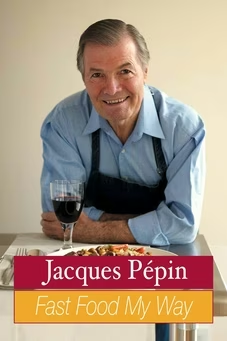
Learn Moreabout PBS online sponsorship- Hello, I'm Jacques Pepin, and one of my favorite meal of the year is the last picnic of our season at the beach or at the apple orchard.
We had a cold snap in the air.
We wear sweaters and watch the sunset earlier every day.
At time like this, I love an earthy rich stew with salad and bread.
Today we'll make lamb shank and beans mulligan, simmered in a Dutch oven until tender and moist.
Cauliflowers Gribiche have the pungent flavor of anchovy, onion and pickle mixed with vinegar and chopped eggs, and for the dessert, juicy grapes, cooked lightly in red wine and spice.
When you have to say goodbye to summer, don't make it so hard.
Make it a celebration and join me on "Today's Gourmet."
(soothing cheerful music) Early winter, you know, one of my favorite menus to do those type of stew, like today we're going to do shank with beans, it make me think of cold, you know, and putting fireplace on and so forth and look at those shank.
Those are very nice shank of lamb.
What you have to do is to remove the fat as I'm going to do here.
Remember that most of it is going to be bone.
You know, you have a big piece of bone and just that very moist, very gelatinous type of meat around which braised a long time.
So what we do for that is just removing the fat.
You can also, if you want, cut the end of the bone here.
You can add the butcher to saw it for you or leave it like that.
It's not that important to do it.
One shank per person.
And with this, we are going to cook this with beans.
I have beans here, dry beans, what they call white bean, or kidney beans, sometime, pea beans, Boston beans, navy beans, all of those are those tiny white beans, you know, that a little bit different in shape, which are fine.
What you have to do, put them flat and you pick out, you know, discolorated pieces or any type of dirt or stone that you have in it.
As you see here in that package, I did pick up quite a few pieces of discolorated beans as well as pieces of stone.
This, of course, you'll discard, and after that, you put that in water.
Very often, you know, we soak it a long time, like overnight, I don't, this is not the technique that I do, I just soak it or wash it in the water.
That's it, you really doesn't have to cook a long time, you know, because if you let them soak overnight, they're going to start almost sprouting, which you don't have to.
And so you can soak them an hour if you want or even no soaking, just washing.
What we are going to do now this is cooked, is really removing though we shall have been browning for like 20, 25 minutes.
You know, you want to brown them long enough to eliminate whatever fat there is on top of it, you know, that's important.
Then you wanna get rid of that fat.
As you can see, I have quite a lot of fat here, so you want to clean up everything out.
No fat left.
The fat will be very strong, especially in the lamb.
You still want, however, the crystallization that I have in the bottom here, this is good.
Now we put that back in it.
(lamb sizzling) Now that it's nice and much cleaner, I can put my beans.
I have half a pound of beans here, all cleaned and water, just plain cold water.
You don't want to put boiling water there because you will have problem cooking your beans.
You have to put cold water and we're gonna put a dash of salt in this, our lid, and that's going to start cooking before we put the garnish in it.
Now we have to put here onion.
I have a nice onion, I have a carrot, I have a whole bunch of things here.
I'm going to put the carrot first, cut the end of it, and you want to peel that carrot, the small planted hand here into one strip, like this, you know, making the carrot, of course, pivot, if you want, on top of your hand without your finger being higher than the carrot so they don't get in the way of the peeler.
Now we put that into little dice, you know, that will be our garnish, onion, again in like one inch piece.
You don't have to worry too much about that.
Remember that this is going to cook for a long time.
So the whole thing is kind of going to fall apart, you know, in it, which is good.
We have four or five clove of garlic here.
Always use a lot of garlic.
Remember that the beans are very good for you.
They are very high in dietary fiber, soluble fiber as well as insoluble fiber that is soluble fiber, good for cholesterol, they tend to lower cholesterol and insoluble fiber is good for your intestine.
All of this is good for you.
We have two bay leaf and finally, I have dry thyme or fresh thyme.
I can put a bit of that fresh thyme in it and all of that is our garnish for this and I'm going to put that in there now.
So right in there, it's nice and colorful.
You know the advantage of those dishes that you can cook that way ahead, you know, not only do you cook it ahead, but it tastes even better when it's reheated and you can reheat it a few times.
You can even freeze it.
In that case here, I have half a pound of beans, which is more than enough for four.
But you could put more beans and less meat, which is more the case at the meal where when I was a child, you know, this has to come to a boil and gently cooking a good hour and a half, hour and a half, two hours depending on your beans.
What I wanna show you, however, now remember you have all that fat that I'm going to discard here.
I wanna show you how to cook eggs.
We are going to have eggs in the next dish that is in our first course, egg as a garnish with cauliflowers.
And I wanna show you how to cook eggs.
You see when you have an eggs, and by the way the eggs can be brown or white.
Apparently the nutritional value is the same.
I kind of tend to like the brown one, but apparently it doesn't make any difference.
You have a round part and a pointed part.
On the round part of the egg, this is what we call the air chamber.
That is there is an airspace, I made a hole in it.
When the eggs is of the day, if you have chicken, like I used to have chicken behind my house, there is no air space because the eggs is very fresh, meaning that if you put that eggs in a solution of water and salt, it goes to the bottom.
After two, three days, it evaporates through the shell.
So you have an air space of about the size of a dime.
The eggs will float in water.
You know it about three days old.
By the time it's 10 days old, the size of this is like nickel, about the size of a nickel, the size of the air chamber inside, meaning that when you put it in water, it'll float to the top.
You know the eggs is about 10 days old.
You see that eggs here, I'll move it from the boiling water When I put it into the water because I made a hole, all of the air will be released there like a little volcano, if it comes out of the eggs here.
So you can put it in boiling water and doing it this way.
If we are not doing that hole here, the eggs will crack most of the time here.
But as you can see here, the pressure is relieved.
The eggs now should boil gently.
And when I say boil gently because people tend to boil the eggs too much, it toughen the albumin and it get hard like a piece of rubber.
It should be a gentle boil for about 9 to 10 minute depending on the side of your egg.
And then after I'm going to show you eggs which are cooked already here.
I just took those out, they've just been cooking that amount of time.
See, one of the first thing that I do after when they are cooked, I pour the water out, you know.
After I pour the water out, I use the pan to shake the egg.
What do I do here?
I shake the egg, you can look at those egg, they're all cracked, you know, everything is cracked there.
Then I drop them in ice cold water, that's important.
You know, when the egg is put in the water, the sulfur in the egg white, which is that strong smell of rotten eggs, you know the sulfur in the egg white will go away from the heat.
So it goes towards the center of the eggs.
When it meet the egg yolk like an happening, you know, it meet the egg yolk.
There is a physical reaction between the iron in the egg yolk and the sulfur and you have that green tinge all around the yolk and that strong smell of rotten egg or sulfur.
What do you do to avoid it?
You crack your eggs, put them in cold water like this.
You can even peel them and usually you peel them under water, you know, like if you were to peel them under water, the water goes between the membrane and it makes it very easy to peel.
Sometime, you know, recipe tell you eggs won't peel if they are fresh of the day.
I tell you I had eggs from the day which peel very well and sometime have very old eggs, which I cannot peel.
So I don't know whether it works, in any case, the best way would be under the faucet, so the water goes right in between here and the egg is easy to peel.
The problem is that it has to stay long enough so the sulfur in the middle of the eggs will feel the cold, it will cross the egg white and dissipate in the water.
At that point, your eggs is going to be right.
I have those eggs which are right and I have some that I have done here which are overcooked and left in water.
And you see what happened here.
You can see all around the egg yolk, that green tinge, and that strong smell of sulfur, you know, those eggs have been boiled too much.
That egg white is like a piece of rubber, you know?
So it seemed to be nothing to do an out-cooked egg, and believe me, it is not that easy.
Another thing that you should know about eggs is that when the eggs is uncooked, like this one is cooked, it's liquid.
That eggs, which is liquid, if I wanna spin it, as you see, it doesn't spin because it's liquid inside.
That egg's is cooked, it'll spin to the point at which it'll stand up.
If it stand up like this, the eggs is totally cooked, totally solid, there's no liquid in it.
That's one way of showing the kid, they like to... Now see if I put my two eggs together, I don't know which is which, I can do this.
And I know right away this one is cooked, I think, yes.
Now here, I wanna show you a nice egg.
This one, can cut it with the knife in half and this will be beautiful.
You see the color that I'm going to have of the green here and this one beautiful yellow color, the way it should be and the egg yolk.
The egg white is much more tender than the other one too, and that's important.
Now, one of the best way to do an egg, to do an egg salad is to use the egg cutter here.
And this is what we are going to use.
So one of the best ways to take your eggs, you cut it across and that of course cut it into slice here.
But then you can do this, grab it this way, turn it around and cut it again.
By then, you know it is chopped just perfectly, remember, it is difficult to chop eggs with a knife because they are very gummy, you know, and it's difficult.
So even this one, I could put another one here.
We may need two for our recipe.
Again, keep them in cold water.
I have them here, cutting my egg this way, then this way, I put them here.
And this is what we are going to use for the cauliflowers.
We're going to use our chopped eggs on top of our cauliflowers.
It's a special recipe we call a sauce Gribiche and we do that with the cauliflowers.
I have those tiny flowers right here that I'm going to cook right away.
I have barely a cup of water here, no salt, nothing.
What I try to do in the cooking of those vegetables, now a great deal is just put enough water so that by the time it's cooked, there is no water left.
So I have no loss of nutrition or anything and usually I don't even put any salt in the water.
I can put the salt later on.
You see that cauliflower here, beautiful tight head, again, part of the cabbage family, broccoli, cabbage and so forth.
Cruciferous family, very good anti-cancer property in there.
I think it was Mark Twain who said that cauliflowers is a cabbage with an education.
You know, that's what it is.
But this is beautiful and tight.
This is the way you want it.
And you see that part here, I use that in soup.
I can cut that into little pieces and use that in one of the soup.
You don't have to lose anything.
Here, however, what we do is really to separate that into what we call floret, you know, which are those little pieces and eventually you cut that even in smaller pieces, you know, when they are really old in winter, you can't even peel the side of it, you know, you can see that if you have a thick, you know, a thick membrane around that you peel it so that it's a bit more tender.
This is what I do also with the broccoli, you know, because often people eat broccoli and they don't eat the stem of the broccoli, the best part of it.
However, you have to take that thick membrane out of it.
What I want to do here next is to cook the dessert.
And what I have here for the dessert, I have red flame grapes, you know, and those are really nice.
You will see actually when it cook, you know some of the pigment from the skin is going to disappear, but this will stand a lot of cooking.
It can withstand cooking.
Great grape to cook.
We're cooking that with a Cabernet Sauvignon here from Sonoma County.
You know, you about a cup of wine or three quarter of a cup and another sweetening agent, a little bit of currant jelly.
You could have grape jelly, would be very nice also in there and a little bit of cinnamon.
What I have here, actually I have a little bit of starch here and the starch, we're going to dilute it with a bit of wine and eventually we're going to thicken that with it after it's cooked for a little while, just to give a bit of viscosity to the mixture.
But for the first time, to start with what we do, bring it to a boil, boil it for five minutes, you know, and now what we're going to do is the sauce for our cauliflowers.
So what we have here is red onion.
We have gherkin here, a kind of gherkin we call, you can use regular gherkin, but in France we use what we call cornichon and the cornichon, C-O-R-N-I-C-H-O-N.
We do them in the garden in Connecticut.
My wife, I plant the cornichon, she pick them up in the morning because you have to pick them small like that.
And they are kept in vinegar, very acidic and crunchy.
This is a specialty in France, we have, of course, parsley and anchovy filet here.
With anchovy filet, as you see are kept in in oil.
And we put about a couple of ounces of this.
We're going to keep the juice.
Even the oil that is coming out of this, I know that the anchovy filet, the one in can like that are quite high in sodium.
You know, salt.
So you take that into consideration in your recipe.
Another thing too is that we use only a little bit of it, you know, other flavoring agent.
So that will go in the bottom of this.
That's it.
Then we put our gherkin and the parsley.
A lot of parsley I love.
And you see, I can gather my parsley together in kind of a bunch and slice it to have coarsely, coarsely chop parsley like this, and finally keep my stem here.
All the stem, I keep that to put into stock or whatever.
What I do a lot at home, when I do a lot of cooking, when I do recipe, I have a bowl in front of me.
What do I do?
The stem of parsley, pieces of carrot, any of that stuff I put in there.
At the end of the day I take, I have a half a gallon of milk in the refrigerator, in the freezer rather, empty and rinsed.
I keep it empty in the freezer, put all that stuff in it.
Next time I cook again, tomato, I put the skin, the juice of the tomato.
When I do a stock, I grab one of those, I cut with a knife right through the frozen block and drop it into a stock pot.
The proportion are not very important and it's a nice way of saving, you know, I have beautiful red onion here, gonna chop our onion across and now this way to a finely diced, finely diced onion.
Yeah, we need at least as much of that, like three quarter of a, and this is our dressing.
You can use that dressing for other thing.
You know, a piece of poached fish is terrific with that dressing.
We put vinegar in there in, you know, I'm going to put olive oil, a couple of tablespoon of olive oil in there, a dash of salt, not too much because of the cauliflower, because of the anchovy and cracked pepper, you know, a lot of cracked pepper here.
And of course in addition to that, I have my half cooked eggs, but I'm not going to mix them in because they tend to break down.
So let's see, the cauliflowers now should be cooked.
It doesn't really cook long.
And as you can see here, I can see that basically I have no water left.
This is what I want, so this, I have all of my nutrient in there, you see, mix that directly in my dressing.
You see, I may have one or two tablespoons of water here and very often I can't even put a dash in there, you know, to extend my sauce.
And if I add a soup going on or a pot or even, you know, the mixture that I put in the freezer, I put that in also.
You know, all of that is good.
And now I'm going to toss it you know, toss it together to mix it.
Maybe be better with the, with a, and as you can see, it's beautiful there, okay?
Okay, and that would be nice, you know, to let it macerate a little bit, to let it so that all the taste get together.
You should not serve that cold, room temperature is great.
If you have to refrigerate it, then refrigerate it, but put it in the microwave oven for maybe 30 seconds or warm it up so that it's not ice cold when you serve it.
Makes a big difference.
Gonna serve that in there.
This is, I love cauliflowers, you know, and we use them in different way, but in that type of salad, and now I say again, you know, you could use that type of dressing for other thing than what I'm doing here.
It's colorful, it's nice.
Okay, I have it here.
We can put our eggs on top of it.
Not only does it give color and taste all over, even a bit more of that red onion, you know that I have on top here, parsley and all that.
Keep an eye for the color also, you know, and I better clean up my table and now I'm gonna put that in the back and see whether my grapes are cooked.
You can see the grapes here.
You see, you will notice how much discoloration you had.
Most of the pigment from the surface of the skin is gone.
You see, this is what happened when you do wine, a lot of wine, a lot of champagne for example, and even a lot of white wine are made with red grapes.
If you press the juice and you don't export the juice to the skin, you will have a white juice.
And often that's called a blonde de noir, you know, a white of black, because as you see, all the pigment of color is in the skin.
In that case, most of it has discolorated now in the juice.
What we want to do is to dilute the starch with a little bit of wine.
Always dilute the starch because if you put a a starch powder like that in something very hot, what happen is that the gluten in the flour, there is a protein in the flour would solidified and you have nice little dumpling all over the place, you know, you don't want that.
I'll push that out to take it off the heat, you know, it's a bit better when you add that directly in it and stir it.
It'll stir, it'll thicken it right away.
Then I put it back on the stove and you can bring it to a boil.
Basically, that's about all for it, you know, this is the proper cover right here.
And now let's see, I have another one here, which is cooked, done exactly in the same way.
And I'm going to serve it as you see now that it cool off, it get even a bit thicker.
You know, I don't wanna mess up my beautiful plate here.
You can serve that by itself.
I mean I have absolutely nothing wrong about serving it, just others without anything else.
If you don't want it to be too rich, if you want splurge a little bit, maybe a bit of, then we can take some of this.
And if you want to put cream in it, cream, heavy cream is going to be like close to 50 calorie per tablespoon.
You know, light cream is going to be like 35.
Now we're going into yogurt, which is going to be much, much less than that.
You're taking about a few calorie there and basically no fat because this is a no fat calorie.
It gives some color to it also, I could do it this way, maybe a little bit in the center.
And again, a little sprig of color, like mint or something else would be there.
And now let's see if our lamb is cooked and I think the lamb is cooked now beautifully.
I'm going to stop it.
You stir it.
This is nice and moist.
All we have, we want to bring that directly to the table.
This way, a bit of herb on top of it, and it's ready for the table.
You know, at the end of the summer when I feel the cold coming, I like to do those type of casserole dish.
Actually, we even do that at the beach in Connecticut.
We go there with a big saucepan, put it on the barbecue and put beans, potato, and cook it there.
It's nice and friendly and a bit cold.
You put a big sweater.
It is that type of dish that I like to do, type of dish that you have with friend and you know, no pretension to it, but very earthy and everyone like that type of dish.
It's good also because it can be reheated.
If you have some leftover, it's perfectly fine.
That menu is quite nutritionally balanced.
You know, I have a lot of different things in it.
I mean, look at the cauliflowers.
We have the cauliflowers Gribiche, we call, and Gribiche in French referred to a type of sauce without cooked eggs that we've done, a lot of onion in it, sometime we even put capers, a lot of parsley, a bit of olive oil, and that's a nice dressing, as I say, that can be served with vegetable like this, or even with fish, you know, thing like this.
Then the stew there, remember you can try to do a stew like this with a piece of lamb from the leg.
If you wanna do a stew itself rather than the shank, you have a lot of bone here.
If you really want to make something very, very inexpensive, then you do it with the lamb breast, very cheap at the market, but then you have to be careful because the lamb breast have a lot of fat in it.
So you have to brown it a long time, you know, eliminate the fat.
Then continue with our recipe.
We have a salad, of course, with our menu and a dessert and the dessert here, we have those grapes cooked with the red wine.
I cooked that with Cabernet Sauvignon and of course, to serve with it, we're going to serve another Cabernet Sauvignon.
This one is from the Medoc.
The Medoc is an area of Bordeaux in the southwest part of France.
You know some of the greatest wine there.
You can always recognize the Bordeaux.
They have high shoulder and the Burgundy low shoulder.
This is Cabernet Sauvignon and Cabernet Franc.
Different type of grapes, akin to the Cabernet Sauvignon we have in the Napa Valley.
It's a very robust, fruity wine, very full, and it's considered the ideal wine to eat with lamb.
I hope you're going to enjoy a glass of wine with your friend.
Do that dish for your friend or your family.
I enjoy making it for you.
Happy cooking.


- Food
Christopher Kimball’s Milk Street Television
Transform home cooking with the editors of Christopher Kimball’s Milk Street Magazine.









Support for PBS provided by: