
September 21, 2026 - PBS News Hour full episode
9/21/2026 | 57m 46sVideo has Closed Captions
September 21, 2026 - PBS News Hour full episode
September 21, 2026 - PBS News Hour full episode
Problems playing video? | Closed Captioning Feedback
Problems playing video? | Closed Captioning Feedback
Major corporate funding for the PBS News Hour is provided by BDO, BNSF, Consumer Cellular, American Cruise Lines, and Raymond James. Funding for the PBS NewsHour Weekend is provided by...
September 21, 2026 - PBS News Hour full episode
9/21/2026 | 57m 46sVideo has Closed Captions
September 21, 2026 - PBS News Hour full episode
Problems playing video? | Closed Captioning Feedback
Where to Watch PBS News Hour
PBS News Hour is available to stream on pbs.org and the PBS app.
Providing Support for PBS.org
Learn Moreabout PBS online sponsorshipAMNA NAWAZ: Good evening.
I'm Amna Nawaz.
Geoff Bennett is away.
On the "NewsHour" tonight: Three news outlets sue the Trump administration after the president strips them of their credentials and bans them from the White House.
How efforts to restrict abortion-related drugs are making it harder to treat other health conditions.
And an American-Israeli captured by Hamas on October 7 holds a concert to help his community heal and share the songs that kept him alive in captivity.
SAGUI DEKEL-CHEN, Israeli Hostage Survivor: The only choice you have is what you're going to have inside yourself, because everything outside your body is not your choice.
(BREAK) AMNA NAWAZ: Welcome to the "News Hour."
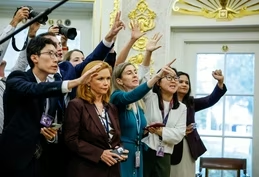
CNN, MS NOW, and Politico are suing the Trump administration for stripping their access to the White House, calling it a -- quote -- "direct assault on the First Amendment."
In a TRUTH Social post this morning, the president wrote that the ban is not an assault on the free press, but on what he called -- quote -- "the fake news, something that's grown like a cancer in our beloved United States of America."
Reporters from the three outlets said they were turned away from the White House over the weekend when they showed up to work.
And, today, CNN was removed from its duties for the rotating pool of TV journalists covering the White House.
The TV pool announced there would be no replacement to cover President Trump's trip to New York ahead of the U.N.
General Assembly.
Our Liz Landers was at the White House today covering it all.
She joins me now.
So, Liz, what did all of this mean for what coverage of the president was like at the White House today?
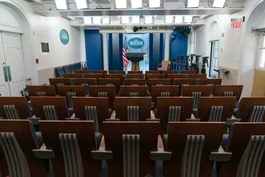
LIZ LANDERS: The coverage today was limited, Amna, and that's because of that solidarity that you mentioned, that the five-TV pool network decided not to cover the president today.
So there was the news this morning that those three news organizations that were removed and banned from the White House grounds, that they formally filed a lawsuit against the Trump administration.
In a joint statement, those news organizations said in part -- quote -- "Without notice or process, the White House revoked our journalists' credentials because it objected to our reporting."
This comes as those outlets tried to access the White House grounds on Saturday and had their credentials taken by the Secret Service.
So CNN and MS NOW instead broadcast from outside of the White House on Pennsylvania Ave on a corner there -- you're seeing that there -- throughout Saturday and Sunday.
This lawsuit today was filed against President Trump, the communications director, the Secret Service director, and the White House chief of staff, Susie Wiles.
The news organizations here are asking for a temporary restraining order in order to have their credentials restored, access restored to the White House grounds.
We're next going to hear from the court about this in a remote hearing at 3:30 on Wednesday.
But, Amna, bigger picture here, this marks another breach of trust between the White House and the press corps, as the president has continued to undermine the free press in both his first and second administration.
As you mentioned, CNN was slated to be the White House press pool today.
I walked by their tent when I was there.
There's some video right there.
The lights are off.
Their booth in the White House basement where we work is across from our space, also all the lights out today.
So CNN was not permitted on the grounds.
And for the first time in modern press coverage, there is not a TV camera traveling with the president today.
We are already seeing the consequences of these actions, though, Amna.
The White House had their own camera that was set up today for this ribbon-cutting ceremony.
I attended this and watched this happen.
There was not a boom microphone and good audio that was set up for this event.
The cameras there could not basically hear anything that the president was saying.
I will add that, once he got to New York City this afternoon, the president did take some questions from reporters at Gracie Mansion with Mayor Mamdani.
He was asked about this press ban, and the president repeated that he feels obligated not to let what he calls fake news into the White House.
AMNA NAWAZ: So we have mentioned the White House press pool a couple of times.
Just remind folks who are unfamiliar, what exactly is the press pool and why does it exist?
LIZ LANDERS: The press pool has really two main functions.
First of all is to reduce the size, the sheer number of people that are traveling with the president and in small spaces at any given moment.
And the other function is resource and cost considerations.
So the TV pool in particular shares the burden of the cost of covering the president.
Every time a TV reporter flies on Air Force One, they pay for that seat in order to maintain the independence of covering the president.
All of the five networks take on this cost-sharing burden each time.
There's usually two cameras that travel with the president, also a boom mic so you get that clean audio and can hear what's going on, usually a reporter and a producer.
And then behind the scenes back at these news networks, a lot of people are involved in feeding this out to all the other pool subscribers.
PBS News has released a statement this evening that says that: "PBS News is a paid subscriber to the White House press pool.
We join our news media colleagues in objection to the White House barring CNN, MS NOW, and Politico from their coverage from the White House.
In support of free and fair journalistic access, PBS News is not publishing video or still images provided by the administration."
The pool is there to ensure an independent account of what the president says and does at any given moment.
And, Amna, I think today the collective action of the pool shows more solidarity in this moment than we have seen in the past when the president has attacked reporters.
I will just add one more thing.
The White House seems to be trying to counterprogram this and announced that they will launch Trump TV tonight on the official White House Web site at 7:00 p.m.
AMNA NAWAZ: Just a remarkable moment.
Liz Landers covering it all.
Thank you, Liz.
LIZ LANDERS: Of course.
AMNA NAWAZ: For more now on the decision to ban CNN, MS NOW, and Politico from the White House, we turn to Jodie Ginsberg.
She is CEO of the Committee to Protect Journalists.
Jodie, welcome back to the "News Hour."
And let's just start with what we heard from the president on social media this morning, defending the ban and also saying the fake news is -- quote -- "a threat to our national security and it must be stopped."
Jodie, what's your response to that claim, framing these outlets as fake news, and also the national security angle the president's stressing here?
JODIE GINSBERG, CEO, Committee to Protect Journalists: Well, unfortunately, this claim that journalists are a threat to national security is the kind of narrative we frequently hear from autocrats, from authoritarian regimes.
It's intended to stir up public distrust of the media and to perpetuate a government-led narrative.
And that's what we have seen from this president is a continual drumbeat of smears against journalists and journalism, the branding of them as fake news, as enemies of the people.
And all of that is intended to sow doubt and distrust and mistrust of the media amongst the public, so that the administration can control the narrative.
But, as we heard, a free press is a cornerstone of the U.S.
Constitution.
It is named in the Constitution and constitutionally protected, not so that we can protect journalists, but so that we can protect all of our rights to receive information about what our government, the government is doing in our name.
AMNA NAWAZ: You mentioned in a statement from CPJ that this ban violates the First Amendment.
Talk a little bit more about what aspects of constitutional law are being tested here.
And now that this will make its way through the courts, as the three outlets are suing, is there existing legal precedent that tells us where this could go?
JODIE GINSBERG: Well, of course, one of those elements is viewpoint discrimination, in that the government is not permitted to penalize news outlets on the basis of their own viewpoints, for using language that he doesn't like.
You may remember the Associated Press was also kicked out of the White House for calling the Gulf of Mexico the Gulf of Mexico, rather than the Gulf of America.
And this is similar to what we're seeing now with CNN, Politico, and MS NOW, that these are being removed from the White House, barred from the White House, simply because they are news outlets whose viewpoint the president doesn't like.
So it's clear that the president, the White House are in breach of the Constitution, of the First Amendment.
We do expect this to be overturned.
And, of course, it is really important that we're seeing this kind of solidarity that you mentioned in the opening -- in your opening remarks because it's important that we stand up collectively and realize this is not a partisan issue.
AMNA NAWAZ: Jodie, folks watching may wonder who don't kind of follow how we work and do our jobs every day, is the White House obligated to provide access to journalists?
I mean, where is the line between managing access and punishing journalists for their coverage?
JODIE GINSBERG: Well, the White House is obligated to make sure that it is providing a broad range of access.
No one has a divine right to sit in the White House press pool, for example, but the White House does have an obligation to make sure that it is making its communications available to a wide range of news outlets.
And what you heard about the press pool is really important.
Often, when the president is traveling, he's traveling on Air Force One, there's not a lot of room, or he's in private small meetings.
We can't have hundreds of journalists attend those meetings.
It's important that we have these shared facilities where one news outlet with sufficient resources is able to cover for the rest and get that information.
I think sometimes we forget that, when you're reading your local newspaper, for example, or listening to your local radio station or watching your local broadcaster, much of that footage is being provided by the pool.
And we saw exactly what happens when that pool coverage is removed.
You could not hear the president today talking about the inauguration of his new helipad because there wasn't the quality of coverage that you would get from having a professional news outlet.
It's extremely costly to do that kind of coverage, and you need professional expertise.
AMNA NAWAZ: Jodie, as Liz reported and you mentioned, the coverage today was already impacted, right, of the president of the United States.
What concerns you most about the precedent this has now set, both for future coverage of future administrations, but also what future administrations may do in targeting journalists?
JODIE GINSBERG: Well, I think this is the important point.
Freedom of expression has to exist for everybody, regardless of their viewpoints and regardless of the viewpoint of the government.
And, of course, if this is the path that the administration wants to go down, there's nothing, of course, stopping a new administration taking a similar action against news outlets that it doesn't like, which is why I think you saw all five of the -- well, all five of the networks come together, even though they don't always see eye to eye politically, to say this was not acceptable and they were not going to continue to run the press pool while CNN was banned.
So those are the kinds of concerns that we have.
And, of course, the other is, if you go down this road in which you say only a Trump TV, only the coverage provided by the White House, only the coverage provided by the government is what the public gets to see, you get a government-controlled narrative.
It is vital for us as the public that we have access to a free and pluralistic media to be able to criticize the government, to be able to analyze what the government is doing, so that we can understand what decisions are being made.
AMNA NAWAZ: Jodie Ginsberg, CEO of the Committee to Protect Journalists, thank you for joining us tonight.
JODIE GINSBERG: Thank you.
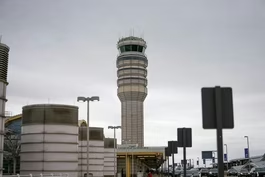
AMNA NAWAZ: In the day's other headlines: The FAA issued ground stops at a handful of major airports on the East Coast today due to an equipment failure.
The stoppage caused hundreds of delays and cancellations in Philadelphia and New York, even as world leaders arrived for the U.N.
General Assembly.
Flights at JFK, Newark, and LaGuardia were able to resume after several hours.
FAA Administrator Bryan Bedford told reporters that a circuit failed at the Philadelphia facility that controls some air traffic in the region, and a backup cable had been accidentally cut at a construction site.
BRYAN BEDFORD, Administrator, Federal Aviation Administration: All data, all data coming through that circuit was lost, so all the services associated with it.
Again, normally, it would roll over to the backup, but the backup fiber was unoperational.
AMNA NAWAZ: Bedford was speaking after an event with Transportation Secretary Sean Duffy to launch a new A.I.-based tool aimed at helping air traffic controllers manage flights in the D.C.
area.
Duffy promised that a human would always be in charge of managing the airspace amid broader concerns about the potential risks of AI.
Paramount settled antitrust concerns with a dozen states today over its buyout of Warner Bros.
Discovery, clearing the way for the $81 billion deal to move ahead.
California's Attorney General Rob Bonta told reporters that -- quote -- "This settlement is not a vote of support for this merger," but he acknowledged that it was the best outcome.
ROB BONTA (D), California Attorney General: We were able to address all of our concerns in the boardroom, instead of the courtroom, and we also got some very important additional commitments from the proposed merge company that will benefit America and California, jobs, workers, the economy, Hollywood.
AMNA NAWAZ: Bonta also laid out details of the deal, which include the creation of independent editorial boards for CNN and CBS and a commitment for increased film production in the U.S.
In July, a group of states sued paramount over concerns that the combined company would wield too much power over the industry.
The settlement still needs final court approval.
Russian drones struck multiple sites in Ukraine overnight into today after Kyiv launched 1,000 drones on Russia this weekend.
Hundreds of drones targeted Moscow, with the mayor calling it the largest ever such attack.
An oil refinery in the city was forced to halt operations.
President Trump has said such strikes on Russian oil sites are responsible for the current jump in oil prices, rather than the war in Iran.
Today, he wrote on social media that -- quote -- "Russia has unfortunately lost control of its diesel oil industry because of the war."
Ukraine's President Volodymyr Zelenskyy responded by stressing that his own country's -- quote - - "energy sector, critical infrastructure, and food exports must stop being targets for Russia."
The two leaders are due to meet on the sidelines of the U.N.
General Assembly tomorrow.
Turning now to the Middle East, where there are concerns about escalating violence on multiple fronts.
In Iran, the paramilitary Revolutionary Guard warned today that the war with the U.S.
is -- quote -- "not over," and threatened to change military tactics and targets if the conflict escalates.
In the meantime, in Yemen, Houthi rebels are telling countries not to back Saudi Arabia in their renewed fighting.
That is according to the Associated Press.
And it comes as "PBS News Hour" can confirm that President Trump was ready to launch airstrikes on the Houthis at the request of Saudi Crown Prince Mohammed bin Salman after having turned down the crown prince's request for airstrikes earlier last week.
But, this weekend, President Trump decided against giving the final order for those airstrikes, according to a U.S.
official.
In Texas, a Venezuelan man who was shot by an ICE officer this weekend is being held at a detention center with a bullet still lodged in his back.
At a press conference today, Wilber Rafael Garces Perez spoke via phone in Spanish, saying he did not receive the necessary medical attention, which a spokesperson then translated.
WOMAN: He was complaining that he was in a lot of pain and he's like: "Are you going to take out the bullet wound?"
And the doctor said: "Hey, they're in a hurry to get you out of here."
AMNA NAWAZ: His lawyer says the 28-year-old was making a DoorDash delivery in Austin when he was confronted by officers and later shot.
They say he has no criminal record.
The shooting sparked protests overnight and calls for an independent investigation.
A DHS spokesperson says Garces Perez entered the country illegally and faces removal.
In Vermont, a jury convicted a man today for attempted murder in the shootings of three Palestinian college students who were walking near his home.
The jury rejected 51-year-old Jason Eaton's insanity defense.
The 2023 attack left one of the victims, Hisham Awartani, partially paralyzed.
ELIZABETH PRICE, Mother of Hisham Awartani: After three years of sorrow, loss, and struggle, our families finally feel relief.
AMNA NAWAZ: Following the verdict, Awartani's mother said that while the trauma cannot be erased, justice has been served.
Eaton now faces a potential sentence of life in prison.
Presley Gerber, the son of supermodel Cindy Crawford and businessman Rande Gerber, has died.
Gerber launched his own modeling career as a teenager in ads for Calvin Klein and on the runway for Dolce & Gabbana, among others.
In 2018, he even appeared in a Super Bowl ad for Pepsi, as his mother had years before.
Gerber was open about his struggles with mental health and substance abuse.
Los Angeles medical records say he died in a rehab facility on Sunday.
No cause of death was given.
Presley Gerber was just 27 years old.
On Wall Street today, stocks rallied to start the week.
The Dow Jones industrial average added more than 350 points on the day.
The Nasdaq jumped about 600 points, or more than 2 percent.
The S&P 500 closed not far from its all-time high.
Still to come on the "News Hour": Tamara Keith and Amy Walter discuss the week's political news; a veteran war correspondent untangles the shifting landscape in the Gulf and the Middle East; and how innovative new suits are helping rescued penguins to heal faster.
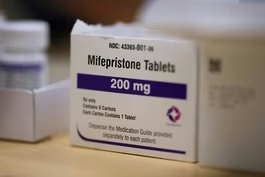
For more than 25 years, the drug mifepristone has been approved for abortion in the United States.
And it's been used safely by more than 7.5 million American women.
But mifepristone and a similar drug have also been proven to treat common and often painful women's health conditions like uterine fibroids and endometriosis.
In the first part of our two-part series "Beyond Abortion," special correspondent Sarah Varney and producer Rachel Wellford traveled to Europe and across the U.S.
to report on this treatment, as anti-abortion groups lobby the Trump administration to further restrict these drugs.
DEJA CRADLE, Uterine Fibroids Patient: I had always had rough periods, since -- I'm going to say since my first period.
SARAH VARNEY: Deja Cradle was just 11 years old when she started menstruating.
DEJA CRADLE: It was horrible cramping.
I would have to sometimes stay home or I would go to school and have to come back home because I'd get so sick that I would, like, vomit.
SARAH VARNEY: And when you went to the doctor or talked to your mom about it, what were you -- what were you told about that kind of experience?
DEJA CRADLE: So my mother would say she had experienced the same thing too when she was growing up.
And then everyone else made it seem like it was just normal.
SARAH VARNEY: And for almost 20 years, that's how it went for Deja, an otherwise healthy young woman growing up in Springfield, Massachusetts.
DEJA CRADLE: I'd started to get random cramps without being on my period as well.
I would say my nausea and pain got worse, to the point where I had to come up with a regimen because my cycles got so bad to the point where I couldn't keep down water.
SARAH VARNEY: And then, in 2013, during a trip to the E.R., doctors determined she had cysts and a hormone imbalance.
But it would take another six years until Deja was diagnosed with uterine fibroids.
DEJA CRADLE: So I went to the emergency room.
They did an ultrasound to make sure I didn't have a blockage.
And then that's when they -- to see how many fibroids I had.
SARAH VARNEY: Fibroids are growths made of muscle and tissue that grow in or on the wall of the uterus, the largest ones to the size of a watermelon.
They're not cancerous, but they are extremely common, affecting 70 percent of white women and more than 80 percent of Black women by the age of 50.
They can cause extreme pain, bleeding, and infertility.
And, on average, it takes more than three years before women get treated.
Many of the treatments available in the United States today involve invasive procedures and surgeries.
The most common one has been hysterectomy, when the uterus is removed.
But there is another treatment that's very effective and noninvasive.
DR.
ABBY LIBERTY, Oregon Health and Science University: Well, this looks like it's definitely trending with interesting patterns.
SARAH VARNEY: Across the country in Portland, Dr.
Abby Liberty says there are two drugs that have been shown to help women with fibroids.
The OB-GYN and researcher at Oregon Health and Science University says those options are not available to women in the U.S.
One drug is an emergency contraceptive, and the other the widely used abortion medication mifepristone.
Both drugs have a long history of safe use, and they work by blocking the effects of a hormone called progesterone.
DR.
ABBY LIBERTY: And so when you block hormones, you're blocking the signal to grow, and you might also be changing the area around the fibroids so that it's easier for the body to make it smaller.
There are a lot of potential creative uses to make surgery more minimally invasive.
Making fibroids smaller means that you have a quicker recovery time, smaller incision on the uterus.
Even minutes in the operating room matter.
SARAH VARNEY: Study after study across the globe has shown that both drugs can shrink uterine fibroids up to 50 percent.
Physicians in China and India prescribe these drugs already to patients with fibroids and endometriosis.
That's when tissue similar to the uterine lining grows outside of the uterus.
REP.
CHRIS SMITH (R-NJ): The abortion pill, mifepristone, is baby poison.
SARAH VARNEY: Anti-abortion groups here have waged a decades-long war against mifepristone.
And they have cast doubt that it's a safe and effective way to treat non-abortion conditions.
Recently, they have turned their sights on the emergency contraceptive known as Ella when it was shown to end an early pregnancy at higher doses.
Earlier this year, the Trump administration launched a review of mifepristone.
Two years ago, Louisiana made the drug a controlled substance.
And, today, Louisiana, Texas, and Florida are suing to restrict access.
Dr.
Liberty and other researchers believe these political forces are halting progress in women's health.
DR.
ABBY LIBERTY: The United States will be left behind because of the red tape around these medicines and the way they have been politically framed.
And so abortion stigma directly limits access to them and investment in them as a potential treatment option.
SARAH VARNEY: And that's led some women to search for treatments on their own.
DANIELLE SHOBACK, Endometriosis Patient: I feel like my period would just always take up like a week of my life and just be like cutting out chunks of my life.
SARAH VARNEY: Danielle Shoback lives in Jersey city, just outside of New York.
The 36-year-old spent more than 20 years suffering from debilitating periods and chronic fatigue that nobody could diagnose.
DANIELLE SHOBACK: It was difficult to, like, take enough medication to be able to sleep, so I was always kind of like getting up and having to take more medication.
And I think, as I got older, it just would get worse, and then was kind of something that I couldn't cover up with just that.
SARAH VARNEY: Danielle ended up in the emergency room multiple times, but doctors gave her no answers.
DANIELLE SHOBACK: I mean, the reason I ended up looking online and trying to figure things out is just because I don't really feel like there were a lot of good options.
SARAH VARNEY: So she started Googling studies and found the results of a clinical trial in China.
That study and others found mifepristone reduced bleeding and pain from endometriosis.
DANIELLE SHOBACK: I brought it up to a couple of doctors, and they thought it was quite crazy.
Like, my gynecologist at the time didn't really take it seriously.
They'd -- a lot -- they didn't really want to try something outside of the box like that.
SARAH VARNEY: Then she found a telemedicine site that prescribes mifepristone to women around the world, including in countries where it's restricted.
DANIELLE SHOBACK: So I basically reached out to that organization and was just like, do you have anyone you can connect me with?
Do you know how I might go about this?
I know it's kind of a crazy sort of thing.
SARAH VARNEY: The person who answered Danielle's e-mail was Dr.
Rebecca Gomperts, a Dutch physician and researcher who has spent her career getting women access to abortion medication.
DR.
REBECCA GOMPERTS, Physician and Researcher: So this is emergency contraceptives.
It sits here.
And this is the Ella one.
This is ulipristal.
And you can just buy it over the counter.
SARAH VARNEY: And this -- you can't get this in the United States over the counter, prescription only.
DR.
REBECCA GOMPERTS: No, you cannot.
It's only prescription.
SARAH VARNEY: Dr.
Gomperts believes there's no reason women shouldn't be able to use medications that work.
DR.
REBECCA GOMPERTS: What is so wonderful about this is that it is such a safe drug, and especially younger women, where it's been researched extensively.
So you have a safe drug that can actually have that effect.
SARAH VARNEY: Dr.
Gomperts says, even in countries where abortion is stigmatized, women still benefit from the same drugs that are restricted in the U.S.
DR.
REBECCA GOMPERTS: I mean, Europe has such a difference.
The institutions are much more resilient to this kind of political pressure and to this kind of intervention from hostile governments.
SARAH VARNEY: And she says there's a lot at risk when countries restrict or even criminalize mifepristone and similar drugs.
DR.
REBECCA GOMPERTS: It will take away very valid treatment options for complaints and diseases that only women have, and thus it will increase disease burden.
It will increase mortality among women, for sure.
So it's a very fundamental discrimination against women.
SARAH VARNEY: Danielle Shoback ended up taking mifepristone for almost two years, until she was finally able to get surgery for her endometriosis.
DANIELLE SHOBACK: I definitely think it -- I don't know if this is dramatic, but it definitely changed my life a lot, maybe saved my life, because I was very depressed about just how much I was missing.
I was missing about, like, half of my life.
DEJA CRADLE: It makes me think about my niece.
What will her options be if she has to go through this?
SARAH VARNEY: And Deja Cradle says it's up to women now to fight for their own health.
DEJA CRADLE: I feel like we have to continue to bring awareness about it, because I think that the country moves when there's awareness.
I feel like it's sort of like the civil rights movement.
Nobody wants to make the laws different until people rally together to bring this to light.
And I think that's what we have to do as women at this point.
SARAH VARNEY: For "PBS News Hour," I'm Sarah Varney in Springfield, Massachusetts.
AMNA NAWAZ: Tomorrow, in the next report, we look at how researchers are exploring more potential for these drugs, including cancer prevention, and how that work is becoming more difficult to do in the U.S.
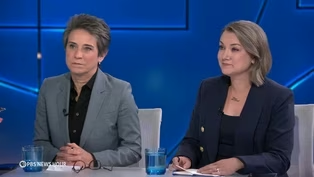
For more on the president banning some news outlets from the White House, Republicans publicly breaking with Trump, and where their party is spending its money for the midterm elections, we turn now to our Politics Monday duo.
That is Amy Walter of The Cook Political Report With Amy Walter and Tamara Keith of NPR.
Great to see you both.
AMY WALTER: Good to be here.
TAMARA KEITH: Hello.
AMNA NAWAZ: You heard Liz's reporting earlier on CNN, MS NOW, and Politico being banned from White House coverage, now suing for access.
Liz also laid out exactly how the TV press pool works and why it exists.
But, Tam, you were the president of the White House Correspondents' Association from 2022 to '23.
You have also covered this president.
What's your reaction to this ban and why do you think the president did this now?
TAMARA KEITH: Why precisely now, I'm not sure.
But this is a pattern that we have seen going back to his first administration.
But, certainly in this second Trump term, we have seen repeated efforts by this president to punish news outlets who do coverage that he doesn't like, including kicking the Associated Press out of the pool, then punishing the wires when he got a judicial decision against him.
He -- and, really, it's not even just about the press, though I could go through a long litany of things that he's done to target the press.
He's also gone after inspectors general and other sources of independent fact that contradicts the reality that he's trying to create for Americans and for his supporters.
His complaint really is, they're reporting things that I don't like.
And that is not a legal justification for kicking just some news outlets out.
AMNA NAWAZ: Amy, why would it be in the president's interest to reduce the coverage he's getting or also ramp up this war with the press?
AMY WALTER: Right.
I'm a believer that the presidency sees the world as he's a hammer and everything's a nail, right?
And so when there's a problem, the hammer always comes down.
This isn't -- not necessarily logical, right, like, walking through all the different steps to say, here's how this is actually going to help my ratings.
But I do think what the president is frustrated about is exactly what Tam's saying, is that, if the news media is reporting on bad poll numbers or a bad economy or things going wrong in Iran, the best way to handle that is to reduce the access to that.
That is not necessarily going to change people's perceptions of those.
So is this going to work?
Are people going to not have access to things that are impacted by the president?
No.
But it just goes to really the core of his value system, which is, when things go badly, his instinct is to shut them down.
TAMARA KEITH: And to double down.
AMNA NAWAZ: We can probably expect some more comments like this in the future.
We should also note the president's facing some public breaking from his own party, several Republicans coming out to speak out against him and some of his policies.
We have reported on this in the past.
Florida Congresswoman Maria Salazar released an ad speaking directly to the president, saying his immigration policies have gone too far.
South Dakota's Republican secretary of state, Monae Johnson, previously refused to acknowledge that former President Joe Biden won in 2020, this weekend endorsed the Democratic candidate, Terrence Davis, to replace her.
And all of this, of course, follows Karl Rove we reported on last week, the former adviser to George W. Bush, saying he will vote for a Democrat in a state race in Texas.
Tam, are these -- are these outliers?
Are they indicative of something else going on in the party?
TAMARA KEITH: This is the beginning of a drip, drip, drip.
There are others.
Tom Tiffany, who was proudly endorsed by President Trump and his race for governor in Wisconsin, not talking about that endorsement anymore, pushing back on the president publicly.
You have seen several -- or at least a couple of Republicans who were in toss-up races vote to -- vote against the president on the war powers resolution last week.
You see candidates emphasizing their bipartisanship, Republican candidates.
You see other candidates weighing in on specific policies, particularly the president's decision to import beef to try to bring down prices, the tariffs related to Canada.
You see sort of limited pushback on a number of things, which is a little -- creating a little bit of space there.
The reason that this is notable at all is because this is a president who requires sort of maximum fealty from Republicans and those in his party.
And any other president and every other president facing a midterm environment like this would say, you do you.
Like, you don't need to stay loyal to me.
You say -- you can criticize me all you want.
George W. Bush did that in 2006.
President Biden did that in 2022.
He had a running joke: I will campaign for you or against you, whichever one will help.
That's not the Trump way.
And so the fact that these candidates are starting to create that separation, I mean, is mostly just an indication of where things stand in this race.
AMNA NAWAZ: Amy?
AMY WALTER: Yes.
And I do think this is a big difference from, say, where we were in 2018, when the president was then going into a midterm year.
Yes, his approval ratings were low, but he had a united Republican base.
It took a while for it to get there.
The first couple of months of his presidency in that first term were a little bit rocky.
But then he got the base together and they stuck with him, and, quite frankly, they have stuck with him through a lot.
This is the point at which - - again, I wouldn't -- I would be careful to say that there's -- they're at a breaking point or that we're watching the party disintegrate.
But the disappointment with the president is leading to some enthusiasm challenges, which I have talked a lot about with you, with Tam about the midterms.
If you look at people who say that they are MAGA supporters first versus party supporters first, those MAGA supporters are much more interested in showing up to vote than the non-MAGA voters are.
And that's really where the challenge sits for Republicans up this year.
It's not that they don't like the president anymore.
It's that they are disappointed enough to maybe stay home.
AMNA NAWAZ: Let's talk a little bit about what we're seeing in this final stretch going into the midterms there, specifically when it comes to the money.
We know Republicans are entering the stretch with a financial edge.
According to the ad tracking firm AdImpact, Republicans and their allies plan to spend about $221 million more than Democrats on advertising through Election Day.
That includes Senate, House, and state races, and that includes $140 million in the nine most competitive Senate races.
Georgia here is the one exception.
That's where Democrats are expected to spend more than Republicans.
But, Amy, I will start with you on this.
We have seen money make a difference and not make a difference.
AMNA NAWAZ: Will it make a difference in these races?
AMY WALTER: Right.
And this is what Republicans are counting on, that especially in the states that are red, the states that Trump won by double digits, they don't need to use that money to convince people who already are upset with the president to change their mind and go vote for a Democrat.
What they need to do is encourage those who right now are Republicans, who want to see Republicans win, but don't feel like their vote is -- that voting for them is all that important.
So theirs is about turnout versus what we saw, say, in a presidential when we're talking about those battleground states and the money going into those.
That was as much about persuasion, trying to ensure that voters in those purple states heard your message.
AMNA NAWAZ: Tam, how do you look at this?
TAMARA KEITH: Yes, I have been digging into these numbers, and what is remarkable here is how many races these super PACs, Trump-aligned groups, and also the party committees, how many of these races that they're spending money on in are in districts that President Trump won by 10 points, 12 points.
Significant.
These are red districts.
These are Trump districts.
One example is Florida 25, which was part of the gerrymander to create a new Republican district.
It's a -- President Trump won that district, or those -- under those lines by nine points.
They're spending tens of millions of dollars on air to try to make that be a Republican seat.
This gerrymander that was supposed to advantage Republicans begins to look like a dummymander if they can't make those seats red.
And it's taking a lot of work.
So that's just also a sign of the political climate.
One Democrat put it this way: "Money can buy you an umbrella, but it cannot change the weather."
AMNA NAWAZ: That's a good way to put it.
Tamara Keith, Amy Walter, great to see you both.
Thank you.
AMY WALTER: You're welcome.
TAMARA KEITH: You're welcome.
AMNA NAWAZ: Now to a deeper look at the Middle East, the recent upheavals there, and the ripple effects across the globe.
Geoff Bennett has that conversation, which he recorded earlier.
GEOFF BENNETT: War correspondent Scott Anderson has spent nearly four decades reporting from some of the world's most volatile places.
Ten years ago, his landmark "New York Times" magazine project "Fractured Lands" traced the lives of six people across the Middle East as war, dictatorship, and the Arab Spring transformed the region.
A decade later, the map has changed again.
Bashar al-Assad has fallen in Syria, the war in Gaza has reshaped the region, and the U.S.
is now at war with Iran.
Anderson's latest book, "King of Kings," examines the fall of Iran's last shah in 1978 and the Islamic Revolution that followed and still shapes Iran today.
And Scott Anderson joins us now.
Welcome to the "News Hour."
SCOTT ANDERSON: Thank you.
It's nice to be here.
GEOFF BENNETT: When you wrote "Fractured Lands," you told this sweeping story through six people.
Ten years later, where are they now?
SCOTT ANDERSON: One is dead, Wakaz, who was a ISIS fighter who I interviewed when he was in prison.
He was hung shortly after I interviewed him.
Two of them are in exile in Europe, one in Austria and one in Germany.
And for the other three, life is kind of a stasis.
It's Majdi, who is in Libya.
And Libya's a failed state.
He's just kind of trapped there.
and, yes, it's just kind of gone on.
GEOFF BENNETT: And how does what happened to them, what does that say about what has happened to the region?
SCOTT ANDERSON: I think that there was a time when there was some optimism for some of these countries.
I remember when I did the "Fractured Lands" project, Tunisia was kind of a bright spot.
Five years on from the Arab Spring revolts, you had a kind of a fledgling democracy there.
That's gone now.
Kind of across the region, things have gone worse.
Certainly, the dictatorship in Egypt under General Sisi is far more repressive than it was under Mubarak.
You have Syria, which is a failed state, Iraq, which is a failed state, essentially.
Things have just become worse and worse, I think.
GEOFF BENNETT: And the Arab Spring promised political change across the Middle East.
Why didn't any of that come to fruition?
SCOTT ANDERSON: There was this golden moment when it looked like finally that was going to happen.
But I think just the powers that be is -- it comes down to the people's guns.
And you saw it in Syria.
And Syria was a classic - - really the saddest case of people rising up against a brutal dictatorship.
and they were just machine-gunned into submission.
And it happened to a lesser extent in Libya.
And the overthrow -- the return of the strongman in Tunisia was more of a of a gradual process.
GEOFF BENNETT: Is the Middle East more fractured today than when you wrote "Fractured Lands," or has the nature of the fracture in many ways changed?
SCOTT ANDERSON: The nature of the fractures have changed.
Now, with the U.S.-Iran war, we're right at the cusp of a whole rearranging of the geopolitical chessboard in the region.
Certainly, the spheres of influence are in flux.
Iran is going to become a much more powerful regional player in a different way than it was before.
It's lost a lot of its proxy fighting allies in the region, but now economically it can -- it can dictate terms to a large degree.
GEOFF BENNETT: So, on that point, does attacking Iran, does it weaken the regime or does it in some way strengthen it?
SCOTT ANDERSON: It strengthens it.
GEOFF BENNETT: Really?
SCOTT ANDERSON: It strengthens it.
In January, there was an uprising against the Iranian regime, and large scale, went all across the country, and the regime realized it was on its -- its back was to the wall, so it machine-gunned its way out of it, killed certainly thousands, if not tens of thousands of people.
Going forward into end of February, when the Israelis and Americans start bombing Iran again, this idea that there is going to be another uprising, that's just not in the cards.
Instead, what happens, because you have this latent and very strong strain of anti-Western, especially anti-American feeling in Iran, nobody likes to be bombed by foreign countries as a general rule.
So, in a way, it just strengthens the regime.
GEOFF BENNETT: Looking broadly at the Middle East, who is most vulnerable in this new order?
SCOTT ANDERSON: I think the Gulf states are at a very sensitive spot.
Certainly, Dubai has built itself up as this transportation hub and a tourism hub.
That's taken a real hit.
And all you have to do is send a few drones over and it scares the -- it scares everybody away.
Planes don't land.
Tourists don't come.
I think Saudi Arabia is in -- is going to be in trouble too for the same reason.
GEOFF BENNETT: You've spent decades reporting on the consequences of American power in the region.
We just marked 25 years after September 11, 25 years of U.S.
power really shaping the Middle East.
Are we watching that era come to an end?
SCOTT ANDERSON: Absolutely.
We're absolutely seeing it come to an end after Afghanistan, after Iraq, now after Iran.
Iran is a fiasco in the making for the American government.
I think the standing of American prestige and power in the region is massively diminished.
One thing I think that the Trump administration didn't take into account is the weaponized drone has changed the face of modern war.
And it's a David-and-Goliath weapon.
And it has -- it doesn't matter how huge an army you have in conventional terms.
That's kind of the great equalizer.
And so aircraft carriers, tanks, they can be blown up by $35,000 drones.
So, no, I think America's prestige is way down in the region and will continue to go down.
GEOFF BENNETT: If American influence is receding, who or what is filling the vacuum?
SCOTT ANDERSON: I think you're going to see regional players coming up.
Turkey is playing a bigger and bigger role, both in the Gulf area and in Central Asia.
I think Israel is going -- is actually weakened by all this.
They were making the Abraham Accords and bringing in Gulf states in recognition.
I think that's going to be much diminished by their actions in Gaza.
It's possible that you will see Iran, again, growing stronger again too.
GEOFF BENNETT: Scott Anderson.
Latest book is "King of Kings: The Iranian Revolution: A Story of Hubris, Delusion and Catastrophic Miscalculation."
A pleasure to speak with you.
SCOTT ANDERSON: Thank you.
Thanks for having me.
AMNA NAWAZ: That conversation was produced in partnership with the Pulitzer Center.
Recently, the small Israeli town of Nir Oz, which was devastated by the October 7 terrorist attacks, held a unique concert.
The singer was not a musician, but a former American-Israeli prisoner who was kidnapped by Hamas on October 7 and held in Gaza for nearly 500 days.
Producer Karl Bostic in Israel and Nick Schifrin report on his story of survival.
NICK SCHIFRIN: In this sun-drenched corner of the country, just two miles from Gaza, they came from all over Israel, 3,000 concertgoers waiting for a story of strength in a place that's still fragile.
A proud father explains.
JONATHAN DEKEL-CHEN, Father of Sagui Dekel-Chen: He's bringing us together here in a way to be -- to have some kind of closure and for him healing, and I think collectively healing as well.
NICK SCHIFRIN: He is Sagui Dekel-Chen.
He's not a professional musician nor singer, but a hometown hero, a father, and a survivor who didn't know whether he or his family would live to share their story.
SAGUI DEKEL-CHEN, Israeli Hostage Survivor: My goal was for people to have a different form of understanding of what happened in Nir Oz and what captivity is.
NICK SCHIFRIN: On October the 7th, 2023, Dekel-Chen was kidnapped from Nir Oz and taken to Gaza after he was shot protecting his family.
A tide of terror had rolled into the kibbutz.
No Israeli community paid a heavier price.
Of 400 residents, more than 40 were killed, another 70 taken hostage.
And the last thing that Dekel-Chen heard, gunmen storming his house with his seven-month-pregnant wife and daughters hiding inside their safe room.
SAGUI DEKEL-CHEN: I heard gunshots, explosions, terrorists screaming inside my house.
So, for me, what are all these noises?
It's game over, right?
So, as far as I knew, I don't have any family to go back to.
But I understood very soon that I'm going to need to lie to myself, because if that's what I'm going to think or believe, I won't survive.
NICK SCHIFRIN: His descent into hell into Gaza's tunnels lasted 498 days.
The conditions were unspeakable.
And that lie often wavered.
SAGUI DEKEL-CHEN: I always had the date of when my wife is supposed to give birth.
But as far as I know, she's -- she's not giving birth to anyone, she's dead.
And I always knew the birthdays of my girls, but my girls are dead.
But I held very strongly this internal lie.
Sometimes, I couldn't hold it anymore, and the lie broke, and then I would just cross into very deep depression, but then the lie would come back to me and I'm alive again.
NICK SCHIFRIN: And that lie in those tunnels forged the crucible of his survival, for, when everything is taken, the last of human freedoms is to choose one's own way.
SAGUI DEKEL-CHEN: The only choice you have is what you're going to have inside yourself, because everything outside your body is not your choice, nothing.
Why not make up songs?
It took me -- it took me a lot of time, and I'm happy it took me a lot of time, because this is what kept me alive.
NICK SCHIFRIN: Kept him alive long enough so he could be part of a prisoner swap.
In February 2025, Hamas paraded him in front of a global TV audience.
He was finally free.
And as he recovered in the hospital, he recorded on his phones the songs he'd composed in captivity, all from memory, without pencil or paper.
NICK SCHIFRIN: Songs of survival and hope.
He imagined they were lullabies for his daughters.
SAGUI DEKEL-CHEN: All these, like, imaginary bedtime routines, it was part of the lie, but I had no choice but to tell to myself that someone's waiting for me.
NICK SCHIFRIN: It turns out they were waiting.
His wife had survived, his mother, his father, Jonathan, and his children, including the daughter that he wasn't sure had even been born.
In captivity, he wrote this song for her: "I still don't know your name."
He knows now.
Shahar, who will soon turn 3, survived to see her father's concert.
So did 5-year-old Gali and 9-year-old Bar, the oldest daughter, with her grandfather, Jonathan.
JONATHAN DEKEL-CHEN: Bar is an incredibly brave girl.
And she survived with her younger sister and her seven-month pregnant mom the massacre on Nir Oz.
And she was also incredibly brave for the nearly 500 days that her dad was in captivity, and none of us knew what the end of that story was going to be.
NICK SCHIFRIN: In some ways, the concert was the culmination of that story, a sharing of his joy, his grief, with thousands of friends and family on a grass lawn that charts the history of Nir Oz and Dekel-Chen himself.
SAGUI DEKEL-CHEN: So I decided doing a concert, and I decided doing it in Nir Oz because this is the only place where it's true.
This grass lawn, I grew up on it.
It's where I had the first date with my wife, Mili.
Later on, I grew up my girls there in that grass lawn.
Later on, I was fighting on that grass lawn.
If there is a line of this is someone who's totally broken, and this is someone who is alive, I think this event was the first time we crossed the line for Nir Oz.
NICK SCHIFRIN: Crossed the line not only for Nir Oz, but also his family.
SAGUI DEKEL-CHEN: The first time my girls agreed to go back to the kibbutz was the day before the concert.
For them, the kibbutz - - there is no kibbutz.
The kibbutz is a bomb shelter with darkness for 10 hours.
This is the only thing they remembered.
And the moment they got off the car into this grass lawn, they were free.
They felt free.
They were running around.
They were feeling like this is their place, this is their home.
NICK SCHIFRIN: His daughter's cards now fill his front door, because, for Dekel-Chen, the true act of triumph was to be able to be a father once more.
For the "PBS News Hour," I'm Nick Schifrin.
AMNA NAWAZ: Finally, tonight, something to make you smile: an innovative treatment helping injured penguins to get back on their feet.
Stephanie Sy has that story.
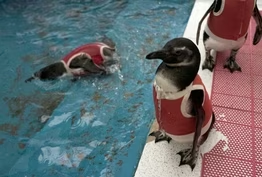
STEPHANIE SY: These penguins are wearing actual penguin suits, but they're more about the substance than style.
Penguins are facing planetary perils, and these special vests are designed to help.
In Chile, injured penguins are swimming, eating, and shimmying in them.
The cocoon of red fabric is woven with healing minerals, copper, which helps prevent bacteria and fungi from growing, and zinc, which encourages new blood vessels to form.
Together, they can repair damaged tissue more quickly.
TOMAS PINO DAMKE, Veterinary Doctor, Humboldt Conservation Center (through translator): The copper suits were born out of the need to manage these wounds when they are in recovery.
These patients generally arrive with wounds in very poor condition, where most of the time we have to perform some type of surgical management.
We have to do cleaning.
We have to do sutures.
And then the challenge was how we treat these wounds in an animal that is wild, that has the ability of great range of neck movement.
It could remove stitches.
It could disturb the wound.
So we had that big problem.
STEPHANIE SY: In the wild, penguins face a number of manmade hazards, but fishing nets can be particularly dangerous.
Penguins are considered one of the most threatened groups of seabirds on Earth, facing pressures including climate change, overfishing, and habitat loss.
Most of the penguins at this facility in Chile arrived with bad cuts and lacerations, likely from fishing nets.
The vet technicians treat and wrap their wounds, then dress them in their special suits.
The suits are made by the Chilean textile company Kimba that until now made suits for animals of the four-legged variety.
ESTEFANIA GUIDOTTI, Head of Textile Marketing, Kimba (through translator): We are working under the hypothesis that this technology could also help penguin recovery.
We have tested it in dogs, cats, and mammals, but, in penguins, this is the first time.
STEPHANIE SY: For now, these penguins are taking their recovery one shimmy and one swim at a time.
But the goal for so many of the penguins injured by fishing nets is to get them back where they belong, in the wild.
For the "PBS News Hour," I'm Stephanie Sy.
AMNA NAWAZ: And that is the "News Hour" for tonight.
I'm Amna Nawaz.
On behalf of the entire "News Hour" team, thank you for joining us.
 New
NewAmerican Israeli held by Hamas performs songs of survival
Video has Closed Captions
American Israeli held hostage by Hamas performs songs of survival and hope (6m 56s)
 New
NewHow abortion drug restrictions impact other treatments
Video has Closed Captions
How abortion drug restrictions make it harder to treat other conditions (9m 20s)
 New
NewNews Wrap: FAA issues ground stops at major airports
Video has Closed Captions
News Wrap: FAA issues ground stops at major East Coast airports due to equipment failure (6m 34s)
 New
NewPress pool declines to cover Trump in protest of his ban
Video has Closed Captions
Press pool declines to cover Trump in protest of his ban on news outlets (5m 10s)
 New
NewScott Anderson on the shifting landscape in the Middle East
Video has Closed Captions
War correspondent Scott Anderson on the shifting landscape in the Middle East (6m 45s)
 New
NewTamara Keith and Amy Walter on Trump's media attacks
Video has Closed Captions
Tamara Keith and Amy Walter on Trump's media attacks (8m 52s)
 New
NewThese copper vests are helping injured penguins heal faster
Video has Closed Captions
These copper vests are helping injured penguins heal faster (2m 25s)
 New
NewTrump's media attacks echo autocrats, Jodie Ginsberg says
Video has Closed Captions
Trump's attacks on free press echo rhetoric used by autocrats, Jodie Ginsberg says (6m 26s)
Providing Support for PBS.org
Learn Moreabout PBS online sponsorship
- News and Public Affairs

FRONTLINE is investigative journalism that questions, explains and changes our world.

- News and Public Affairs

Today's top journalists discuss Washington's current political events and public affairs.











Support for PBS provided by:
Major corporate funding for the PBS News Hour is provided by BDO, BNSF, Consumer Cellular, American Cruise Lines, and Raymond James. Funding for the PBS NewsHour Weekend is provided by...