
Iran demands U.S. pay for war damage before reopening strait
Clip: 8/10/2026 | 6m 7sVideo has Closed Captions
Iran demands U.S. pay for war damage before agreeing to reopen Strait of Hormuz
Iran doubled down on keeping the Strait of Hormuz closed until the U.S. meets a sweeping list of demands. President Trump scoffed at those conditions, especially paying reparations to Iran for damages caused by five months of U.S.-Israeli bombardments. The impasse comes as war appears closer in Yemen between a Saudi-backed coalition and Iran-backed Houthi rebels. Nick Schifrin reports.
Problems playing video? | Closed Captioning Feedback
Problems playing video? | Closed Captioning Feedback
Major corporate funding for the PBS News Hour is provided by BDO, BNSF, Consumer Cellular, American Cruise Lines, and Raymond James. Funding for the PBS NewsHour Weekend is provided by...
Iran demands U.S. pay for war damage before reopening strait
Clip: 8/10/2026 | 6m 7sVideo has Closed Captions
Iran doubled down on keeping the Strait of Hormuz closed until the U.S. meets a sweeping list of demands. President Trump scoffed at those conditions, especially paying reparations to Iran for damages caused by five months of U.S.-Israeli bombardments. The impasse comes as war appears closer in Yemen between a Saudi-backed coalition and Iran-backed Houthi rebels. Nick Schifrin reports.
Problems playing video? | Closed Captioning Feedback
How to Watch PBS News Hour
PBS News Hour is available to stream on pbs.org and the free PBS App, available on iPhone, Apple TV, Android TV, Android smartphones, Amazon Fire TV, Amazon Fire Tablet, Roku, Samsung Smart TV, and Vizio.
Providing Support for PBS.org
Learn Moreabout PBS online sponsorshipGEOFF BENNETT: Today, Iran again insisted it will keep the Strait of Hormuz closed until the U.S.
meets a sweeping list of demands.
President Trump scoffed at those conditions, especially paying reparations to Iran for damage caused by five months of U.S.-Israeli bombardments.
The impasse over the strait comes as war appears closer in Yemen between a Saudi-backed coalition and the Iran-backed rebel Houthis.
Here's Nick Schifrin.
NICK SCHIFRIN: If the U.S.
thought it was close to a deal that would allow ships in and out of the Strait of Hormuz, this weekend, that hope appeared dashed.
Iranian national security officials issued a sweeping set of demands for Iran to open the strait.
The U.S.
must lift the naval blockade and withdraw nearby troops, remove sanctions on Iran, and release Iranian frozen assets, pay Iran reparations, and end attacks on Iranian proxies, including Israel's strikes on Hezbollah.
Those are dead on arrival, especially before Iran takes its own steps.
But they were echoed today by Foreign Ministry spokesman Esmaeil Baghaei.
ESMAEIL BAGHAEI, Iranian Foreign Ministry Spokesman (through translator): As long as other U.S.
violations continue, the necessary conditions will not be in place for us to say that the Strait of Hormuz has become a safe waterway.
NICK SCHIFRIN: That's not the message Iran sent last week, when four regional and U.S.
officials told "PBS News Hour" that Iran and Oman agreed that ships entering the strait would sail near Iran and ships leaving the strait would sail near Oman in a temporary deal that would restart the cease-fire and was supported by the rest of the members of the Gulf Cooperation Council.
DONALD TRUMP, President of the United States: Can they make trouble?
Yes, they can make trouble, but they're broke.
NICK SCHIFRIN: Today, President Trump tried to flip the script on Iran's demand for reparations.
DONALD TRUMP, President of the United States: They asked for money for the damage that we have done.
And I said, that's a good idea.
Well, we're going to ask for money for the damage they have done over a 50-year period.
NICK SCHIFRIN: The president cited the thousands of American service members killed or wounded by Iranian bombs in Iraq,as well as tens of thousands of Iranian protesters killed by the regime and the 2000 bombing of the USS Cole, although that was led by al-Qaida.
But Iran's security apparatus is responding to U.S.
pressure by consolidating power, this weekend naming a 71-year-old former Revolutionary Guard Corps commander as its new top national security adviser.
ABBAS MILANI, Stanford University: The ones who have the upper hand right now are the ones who think they send the bargain for a much, much, much better deal.
NICK SCHIFRIN: ABBAS MILANI is Stanford University's director of Iranian studies.
ABBAS MILANI: They know Mr.
Trump doesn't want a prolonged war.
They know he wants out of this at best he can.
So they think they have some leverage there, and they're using that leverage.
NICK SCHIFRIN: A senior U.S.
official tells "PBS News Hour" the administration is patient and considers this not a setback, but a step in the process.
As President Trump told Axios' Barak Ravid this weekend: "We are low-keying it.
We are only semi-negotiating with them.
We are just watching Iran with its huge inflation and the fact they have no money."
ABBAS MILANI: As an American commentator said, it's the economy, stupid.
It is the economy, stupid.
If you can't feed your people, if you can't feed your army, if you cannot make payroll, the Iranian regime has actually literally had problems.
You can't fight a war with the world.
But the leverage they think they have is that they think they have won this battle with the United States, won the battle with Israel.
NICK SCHIFRIN: And it's not just Iran itself.
The Iranian-backed Houthis are also trying to exert maximum leverage.
The Houthi rebels in Yemen released this footage showing its first attacks in more than four years on multiple fronts.
The Houthis struck the Port of Mocha, controlled by the internationally recognized Yemeni government, killing both soldiers and civilians.
The Houthis have also attacked in Southern and Eastern Yemen at Yemeni troops and what the government called camps for displaced civilians.
Yemen's military vows to respond.
COL.
MAJED AL-NAZILI, Yemeni Military Spokesman (through translator): We emphasize that any attack on one front or axis is considered an attack on all fronts and axes of our armed forces.
NICK SCHIFRIN: The Houthis have also launched cross-border attacks at Saudi Arabia's energy facilities.
The Houthis and Saudis fought a nearly-decade-long war that for the last four years has been in a tentative cease-fire.
The U.N.
warns the strikes over the last few weeks threatens to restart that war.
MOHAMMED AL-BASHA, Founder, Basha Report: The Houthis here are assuming that nobody is ready for ground operations and nobody wants to escalate to full-scale war.
And so they're pushing the boundaries, hoping that this maximum pressure tactic will get them what they want.
NICK SCHIFRIN: Mohammed Al-Basha founded the U.S.-based risk advisory Basha Report and has advised governments in the private sector.
MOHAMMED AL-BASHA: I call this missile and drone diplomacy, where they're using military tactics for negotiating.
But I think they have to be very careful right now because the Saudi-led coalition and the government forces on the ground have already started losing personnel.
They're not going to just sit back and be sitting ducks for the Houthis to shoot whenever they want.
They will have to retaliate eventually.
NICK SCHIFRIN: And as Iran maintains its choke hold over the Strait of Hormuz, the Houthis are threatening to shut down the Bab al-Mandab right next to territory they control and a vital shipping route that's a gateway to the Red Sea.
MOHAMMED AL-BASHA: They're sending a signal to the U.S., they're sending a signal to the international community that they could close the Bab al-Mandab Strait, that they could disrupt the Red Sea traffic in the Gulf of Aden.
And, by doing that, it is definitely serving Iran and serving Iran's interests, but it's also serving the Houthis' interests.
NICK SCHIFRIN: And making it more difficult for the U.S.
and its allies to extract itself from a war they started, but now have no way to end.
For the "PBS News Hour," I'm Nick Schifrin.
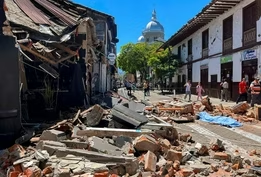
7.4-magnitude earthquake rocks Colombia
Video has Closed Captions
Clip: 8/10/2026 | 2m 26s | 7.4-magnitude earthquake rocks Colombia, crumbling homes and buildings (2m 26s)
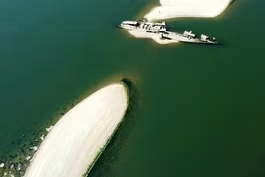
Danube's critically low level reveals relics from the past
Video has Closed Captions
Clip: 8/10/2026 | 1m 20s | Danube's critically low level reveals relics from the past (1m 20s)

Family of Marine veteran held in Russia says he's near death
Video has Closed Captions
Clip: 8/10/2026 | 6m 15s | Family of Marine veteran imprisoned in Russia warns he's near death (6m 15s)

How pop culture and social media are changing how people talk
Video has Closed Captions
Clip: 8/10/2026 | 3m 17s | How pop culture and social media are changing how people talk (3m 17s)

News Wrap: Trump signs order on childhood vaccines
Video has Closed Captions
Clip: 8/10/2026 | 5m 26s | News Wrap: Trump signs order calling for MMR vaccine split into 3 shots (5m 26s)

State voting officials join CISA election security call
Video has Closed Captions
Clip: 8/10/2026 | 4m 36s | State voting officials join CISA security call with election 85 days away (4m 36s)
Tamara Keith and Amy Walter on outsider candidate success
Video has Closed Captions
Clip: 8/10/2026 | 8m 45s | Tamara Keith and Amy Walter on the energy behind outsider candidates (8m 45s)

What Meta's open-source model means for the future of AI
Video has Closed Captions
Clip: 8/10/2026 | 6m 42s | What Meta's new open-source AI model means for the future of artificial intelligence (6m 42s)
Providing Support for PBS.org
Learn Moreabout PBS online sponsorship
- News and Public Affairs

Today's top journalists discuss Washington's current political events and public affairs.

- News and Public Affairs

FRONTLINE is investigative journalism that questions, explains and changes our world.











Support for PBS provided by:
Major corporate funding for the PBS News Hour is provided by BDO, BNSF, Consumer Cellular, American Cruise Lines, and Raymond James. Funding for the PBS NewsHour Weekend is provided by...