
What the Supreme Court's Voting Rights Act Ruling Means
Clip: 5/4/2026 | 11m 55sVideo has Closed Captions
The 6-3 decision is expected to have long-lasting ramifications.
President Donald Trump ignited a conflict over redistricting last year by urging Republicans to redraw congressional maps to reduce the likelihood that his party loses the U.S. House in the November midterm elections.
Problems playing video? | Closed Captioning Feedback
Problems playing video? | Closed Captioning Feedback
Chicago Tonight is a local public television program presented by WTTW
WTTW video streaming support provided by members and sponsors.
What the Supreme Court's Voting Rights Act Ruling Means
Clip: 5/4/2026 | 11m 55sVideo has Closed Captions
President Donald Trump ignited a conflict over redistricting last year by urging Republicans to redraw congressional maps to reduce the likelihood that his party loses the U.S. House in the November midterm elections.
Problems playing video? | Closed Captioning Feedback
How to Watch Chicago Tonight
Chicago Tonight is available to stream on pbs.org and the free PBS App, available on iPhone, Apple TV, Android TV, Android smartphones, Amazon Fire TV, Amazon Fire Tablet, Roku, Samsung Smart TV, and Vizio.
Providing Support for PBS.org
Learn Moreabout PBS online sponsorship>> I dissent then from this latest chapter in the majorities now completed demolition of the Voting Rights Act, that Supreme Court Justice Elena Kagan in her dissent of a 6 to 3 ruling last week in Louisiana versus Callaway.
The ruling determined that Louisiana's congressional maps, which include 2 majority minority districts designed to give minority voters a chance to elect their preferred representatives are unconstitutional.
The decision is expected to have long-lasting ramifications.
That could be felt as soon as the 2026 midterms with states racing to reach redraw their maps before November.
Joining us to break down the ruling are Ryans Holley executive director of Change, Illinois, a nonprofit that advocates for fair legislative maps in Illinois.
Michael King, a law professor at Northwestern University and Karen Freeman, Wilson, president, CEO of the Chicago Urban League.
Welcome back.
Thanks to all of you for joining us.
Michael King, I want to start with you, please.
What was it that the judges were being asked to consider in this case?
Break it down for us.
Please.
>> Yes, technically speaking here, Louisiana was ordered by a lower court, too.
Draw second majority minority District under Section 2 of the Voting Rights Act, which it basically guarantees minority representation under certain conditions that it seems that minorities are being denied their kind of fair share of representation.
That was appealed up to the Supreme Court in what the state ended up arguing was that the intentional drawing of the second district that it was being asked to do one of the Voting Rights Act is unconstitutional, that it unconstitutionally considering race by the state that defied kind of voting Rights Act practice for 50 years.
But we have a different court that's ready to consider this sort of change.
And they declared that consideration of race in the intentional drawing of this majority minority district unconstitutional.
This has huge ramifications for the way that politics are conducted in the way that we think about voting rights.
>> Karen, from Wilson, what was your reaction to the court's ruling?
Well, the ruling was really a good.
>> Punch brandis further evidence that over the last 13 years, this Supreme Court has been intent on not only gutting the Voting Rights Act, but eliminating the Voting Rights Act.
And this.
In many respects was the final nail in the coffin.
>> Brian Todd Lee, the Republican governors of both Alabama and Tennessee.
They have called for special legislative sessions to potentially adjust their congressional maps ahead of the midterms.
We just heard Michael King say it that there could be long-lasting ramifications.
What could the effects of this ruling be on the 2026 elections?
Yeah, there's a few states, as you said are already considering redrawing the maps because these legal tolls that voters had.
>> To ensure their representation are gone and what we're likely to see is just lot more partisan gerrymandering because voters don't have those tools to fight back 2026.
Some states are going to be constrained because they already have primary Pastore.
They're too far into petition process.
But especially for 2028 and beyond, it's just going to be wide open for states to gerrymander like we haven't seen previously.
>> I'm going see you Great.
Go ahead, Karen.
No, I was just going to say in Louisiana, they literally canceled or postponed an election so that they could change the It's sort of like changing the rules in the middle again.
But this isn't a game.
That's important part.
So it's all it's already happening is what you're saying.
Michael, paying the Roberts court has weakened the Voting Rights Act twice before once in 2013 again in 2021.
>> Remind us of those rulings, please.
>> Yeah, this is really the 3rd act in a larger kind of deconstruction of voting rights by this court.
The 2013 decision was Shelby County.
And that got rid of the really important part of the Voting Rights Act section 5 that basically forced covered jurisdictions to prove before it could implement any sort of change their election rules that they were not discriminating either in terms of a factor or intent that was wiped away.
And what that meant was a lot more pressure fell on the remaining provision in the Voting Rights Act section to Section 2 is a little different.
It's not a preclearance provision that requires plaintiffs to come forward and see what after an election changes been made.
If general even apply to redistricting.
So in a decision a few years ago, Brundage.
Basically the court had to review how to apply section 2 to election rules, changes that previously had fallen under Section 5 before Shelby County.
A lot of conservatives had argued that we don't need Section 5 because we have section bring a bench that section 2 application to these election rule changes was made much more difficult.
And really there hasn't been a successful section to see sense.
So those were 2 elements that came in.
And this is the 3rd part which basically makes it almost impossible to bring a successful section to see in redistricting, which is where Section 2 had had a lot of force ensuring some minority representation, particularly in the south.
But but other than the south as well.
And this now requires proof of intentional discrimination, which is very hard to prove in litigation.
And you have to show not only that minority voters are being hurt, not just in terms of the a fact, but because of race as opposed to party to the degree that.
You have a Republican government that is intent on advancing Republican that hurting Democrats, even if they target black voters say who vote Democratic.
That seems according to the court.
Okay.
Because that's kind of partisan discrimination and the court in.
And yet another decision had decided the Constitution has no restrictions on partisan gerrymandering.
So when you combine all of those things, you're likely to see partisan gerrymandering, just go crazy.
>> So I want to get into one of the things that you mentioned there, Michael, with Karen.
Karen, the court ruled, as we just heard that the state legislatures are allowed to redraw maps in pursuit of political ends, right?
That is so allowing Republicans to target minority populations as Democrats rather than targeting them as black voters, Hispanics.
So on, what's your reaction to them?
Leaving that open?
Well, I think it just >> creates an opportunity.
>> For people to change maps.
>> To disenfranchise voters to essentially.
Use the the partisan political issue a pretext for really discriminating racially.
And while you can't prove intent, we always see the impact.
And so the impact will be there without any protection against it because people will be able to use the pretext.
We're not just focused on race.
We're really focused on political party and we just want this to be a Republican or super majority Republican state.
And so next door to in Indiana.
My home state, there is peril.
seen too.
Districts that are represented by Democrats that have a significant black population essentially having those people that vote, Democrat, disenfranchised in the interest of advancing a did gender.
>> So, Ryan, some advocates are urging Democrat led states then to respond in kind by redrawing districts to favor Democrats.
We've already seen California and Virginia revisit their redistricting moves after Texas.
And you've already mentioned concerned about this sort of setting off redistricting, arms race, sort what could the impact be for for voters?
Will we see what Karen Freeman Wilson just referenced, fewer majority minority districts?
Yeah, I think that's absolutely a reality we could be facing.
>> I think for a lot of state.
So we have to remember who is losing out here and it's boaters and for states like Illinois, there are tools available to us to protect Illinois voters.
There's legislation in the state House credit, Illinois Voting Rights Act that would ensure a lot of these protections for vote dilution voter suppression.
And I don't want us to lose sight either that this is also going to affect state maps.
It's going to affect local maps.
And so it's really important for state like Illinois to lead the way on protecting voting rights by ensuring our state passes legislation that gives us protections to voters.
And we don't see similar things happening, Illinois, with them.
Bernard, but both leash and voter suppression.
>> Be and since you mentioned Illinois Governor JB Pritzker.
He has entertained redistricting in the past talks about amending the state constitution to bolster the protections of the vra.
You mentioned that should.
Illinois.
You mentioned Illinois Voting Rights Act.
Should Illinois be passing this house other states responding?
Yeah, absolutely.
I think it's something that is that within the power of the Illinois state legislature to pass and we should do that immediately.
We should be example for other states.
>> On how we can ensure voters are protected with the last of these federal safeguards.
it's it's not going to be the end, all be all to to fix a problem nationally.
But we got to remember, we have to start somewhere in a state like Illinois can lead the way here, Karen from Wilson.
But Roberts court has long held that policies should not consider race whether it is to help or hurt.
>> Minority populations that sort of race blind argument.
>> What did you make of that policy is just should stop discriminating on the basis of race period.
I think it's fictional.
>> And when you look at the fact that we have not existed in a color-blind society for 400 years to say that today we're going to start being color blind.
>> Miss placed effort to negate history.
And you just cannot do that.
You can do it.
Obviously, the court hands, but mythical.
>> Michael Caine, we've got about 30 seconds left.
You know, the Roberts court has you know that we mentioned made some decisions before.
Has this case fit into the broader pattern of the court's approach to race, conscious loss?
>> I think it's of a piece with all the other decisions.
It's attempt to get law out of regulating race discrimination in all different kinds of ways.
And so I think to the degree that you're worried about discrimination in voting and in politics are worried about racial representation getting wiped out this case sort of completes a kind of retreat by the court of law from that space.
>> Okay.
That's what we'll have to leave it More to come on this.
I'm not sure.
Michael Caine, Karen Freeman, Wilson, Ali, thanks to the 3 of you for joining us.
I appreciate it.
Thanks so much.
Thank you so much.
Brandis.
Up next, serving up Filipino cuisine and culture with Chicago restaurateur Billy DEC.
>> Reflecting the people and
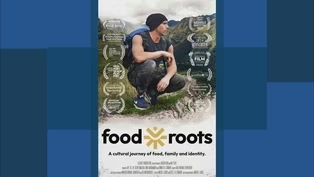
New Documentary Explores Filipino Culture and Cuisine
Video has Closed Captions
Clip: 5/4/2026 | 8m 15s | "Food Roots" follows restaurateur Billy Dec as he returns to the Philippines. (8m 15s)
Providing Support for PBS.org
Learn Moreabout PBS online sponsorship
- News and Public Affairs

Top journalists deliver compelling original analysis of the hour's headlines.

- News and Public Affairs

Today's top journalists discuss Washington's current political events and public affairs.












Support for PBS provided by:
Chicago Tonight is a local public television program presented by WTTW
WTTW video streaming support provided by members and sponsors.